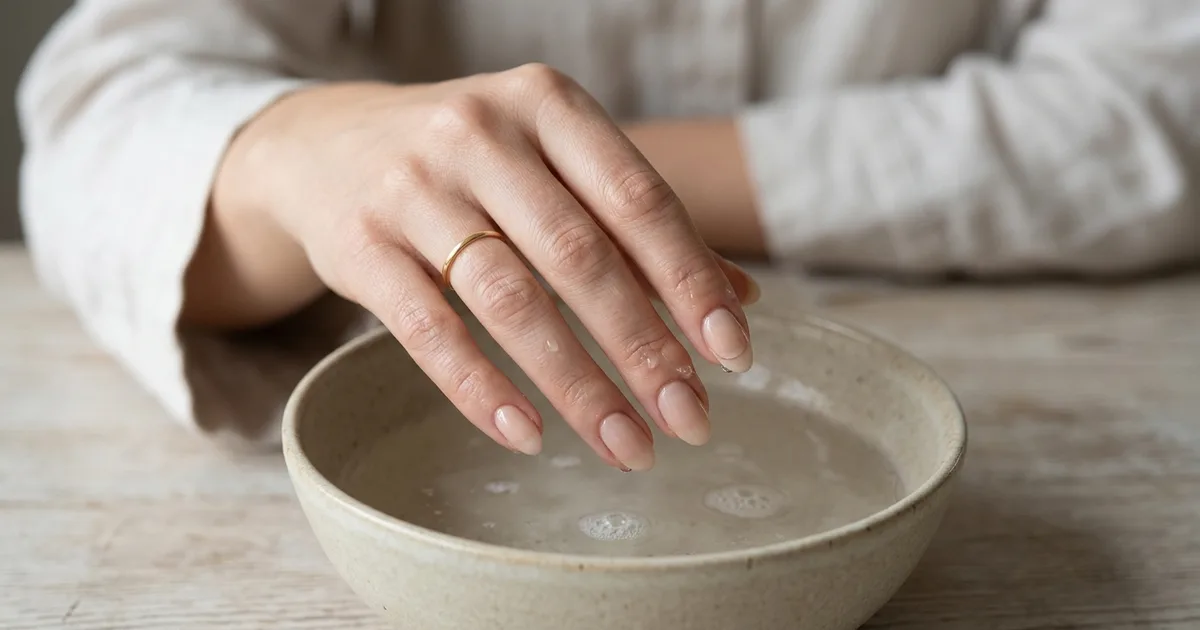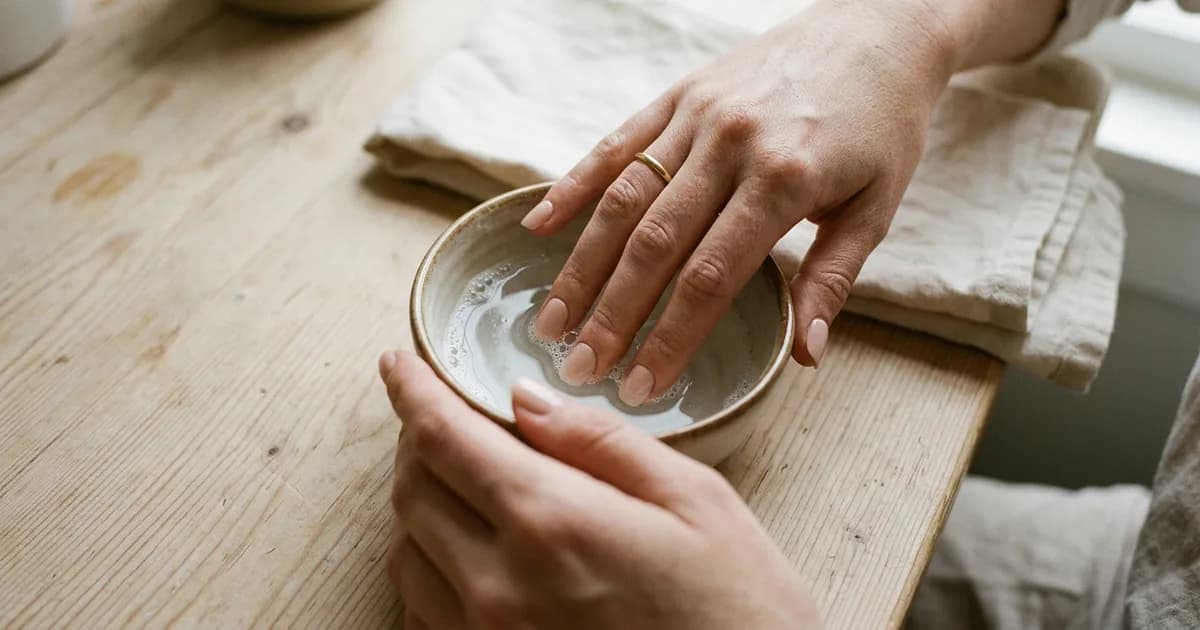
The gentle way to remove press-on nails is warm soapy water and time, not tools and force. Rest your fingers in a bowl of comfortably warm water with a little mild soap, leave them for ten to fifteen minutes, and wait until the glue lets go on its own. The set slides off without taking your nail with it.
Most guides stop there, at the soak. None of them tell you how a loosened nail actually feels, what to do with the one nail that refuses, or why you should not file off the glue residue afterwards. That last part is exactly where a nail either comes away whole or has a rough week for no reason.
The gentle method, step by step
The whole method is warm water, a little oil and enough time. No part of it asks you to pull, to prise hard, or to slide anything metal under the edge.
- Warm soapy water. Fill a bowl with comfortably warm water and a few drops of mild soap or shower gel. Put your hands right in, and leave them for ten to fifteen minutes while the water works its way under the edge.
- Oil into the seam. While the nails are still warm and damp, work a little cuticle oil or cooking oil into the seam at the base and along the sides. The oil creeps into the gap the water has opened.
- Rock, do not prise. Take a wooden orange stick, press it gently in at the base, and rock the set slowly from side to side. The word is rock, not snap.
- If it holds, back into the water. A nail that is still stuck is not ready. Top the bowl up with warm water and go again. Two rounds is completely normal.
Do not use acetone. It dries the nail out and leaves it brittle, and you do not need it when warm water and a little time dissolve the glue just as well.

How to tell the glue has let go
A nail that is ready to come off sits loose and moves freely when you rock it, without any pain and without you having to force it. If you feel resistance, or a small tug deep at the nail root, the glue is still attached, and the answer is more water, not more force.
That is really the only test you need. If it hurts, you stop. A nail that gives way with a little click while you can still feel it clinging drags the top layer of your own nail out with it, and that is precisely what we are trying to avoid.
For me it is nearly always the thumb and the middle finger that let go last. They sit tightest, and they usually need an extra round in the water while the others are already lying on the table.
The nail that will not budge
If you have a nail that will not come off after two rounds in the water, the right move is to leave it until later in the day or until tomorrow. A nail that refuses is only telling you the glue needs more time, not that you need more force. We have written more about the one nail that will not come off, and what to do with it.
It feels backwards to stop when nine nails are off and one is still on. Even so, that one nail is not a problem you solve with a stick, it is a problem you solve with patience. Take another warm soak, or wash up without gloves for half an hour, and try again once the skin around it has softened.
What you never do is press anything metal under the edge, or snap the nail off because the rest are done. No rush, no force. The last nail comes too.
Glue residue, without filing
Once the set is off, there is often a bit of dull, whitish glue left on the nail. The advice you find almost everywhere is to file it away, and that is exactly where most people end up filing off nail instead of glue.
Do this instead: put the nail back in the warm soapy water for another couple of minutes, and push the residue gently off with the orange stick or a soft cloth while it is soft. A little oil on a cotton pad takes the rest. The glue stays soft as long as it is warm and damp, and then you do not need the file at all.
The file cannot tell glue from nail. Warm water can.

Your nail afterwards, and the break
But how is the nail doing afterwards? Usually it is a little dry and feels thin on top, and it is mostly just the outer layer that has had a rough week.
Give the nail a little oil in the evenings for a few days, and hand cream more often than you think you need. If it feels sore or rough, it is worth leaving it a couple of days without a new set, so it can dry out and recover before you glue again. What a nail needs between two sets is mostly moisture and a bit of peace.
Some people like to keep a set on almost all the time, and that is fine as long as you build in breaks now and then and never glue over a nail that is already sore, lifted or discoloured. If the nail underneath really looks wrong, with swelling or a colour that does not belong there, that is one for a pharmacist or a doctor, not a guide.
How to make the next removal easier
The easiest removal is the one you set up when you glued the set on. Two choices make the most difference.
- Glue just inside the cuticle, not right up against it. That leaves you a small edge to reach later with water and a stick, and the set loosens more evenly. It is also one of the reasons nails lift at the edge when the glue sits too close to the skin.
- Adhesive tabs when you only want the set for one evening. They sit for a shorter time, they give way in warm water with nothing else, and the nail underneath barely notices they were there.
How you put a set on in the first place is closely tied to how easily it comes off again. The full walkthrough of getting a set to stay on lives on our pillar page.
We also run the xnails.no shop, so you should know where the advice here comes from. We do not recommend anything because we sell it, we write down what left the nail most in peace.
Questions we get about removing press-on nails
How long does it take to remove a set?
Reckon on twenty to thirty minutes for a full set done gently, sometimes a little more. The soak itself is ten to fifteen minutes, and then the nails come off one by one. If you are short on time, it is better to wait until you have a calm moment than to rush and pull.
Can I shower or bathe to loosen them?
Yes, a long, warm shower or a bath softens the glue the same way the bowl of soapy water does. Many people find it easier to rock the nails loose right after a bath, while the skin and cuticle are still soft. Just avoid picking at them mid-shower, when you cannot see what you are doing.
Can I reuse the set afterwards?
Sometimes. If the nail comes off whole and you get the residue off the back with a little oil, a set can happily be worn again. If it is cracked or full of old glue, it is done. Your nail matters more than saving a set anyway.
My nail feels thin afterwards, is it damaged?
Almost never. A nail that feels thin and a little rough right after a set has usually only lost a bit of the outer layer, and that grows back. A little oil and a few days without a new set do more than you would think.