Press-on nails from sizing to gentle removal
Everything we have learned from wearing sets through ordinary weeks, gathered on one page. Sizing, prep, application, wear time, and a removal that leaves your nail alone.
Press-on nails are ready-made plastic nails that you attach to your own nail with glue or adhesive tabs. They go on in about fifteen minutes, and a set typically stays put for five to ten days. The gap between those two numbers is almost always about preparation rather than about which set you bought.
Below is the whole way through a set, in the order you meet it: measuring, prep, application, the week that follows, and the removal that decides how your nail looks afterwards.
What press-on nails are, and how they differ from gel and acrylic
A set of press-on nails is a tray of pre-shaped plastic nails, usually ABS, in ten to thirty sizes so you can pick the one that fits each finger. They attach with nail glue or adhesive tabs, and they sit on top of your natural nail with nothing cured, sanded or built up.
That is where they part company with gel and acrylic. Gel cures under a UV lamp directly on your nail, and to make it bond, many salons take the shine off the plate first. Acrylic is built from powder and liquid and needs an infill every two to three weeks. Both turn your nail plate into part of the structure, and both have to be filed back off when the set comes away.
Press-ons stay on the outside. The nail underneath is the same when you take them off as it was when you put them on, as long as you are patient at both ends.
| Comparison | Press-on nails | Gel nails | Acrylic nails |
|---|---|---|---|
| Application | At home, 15 to 30 minutes | Salon, or a UV lamp at home | Salon |
| Sanding your own nail | None | Often | Usually |
| Wear time | 5 to 10 days | 2 to 3 weeks | 2 to 3 weeks, then an infill |
| Removal | Warm soapy water and time | Filing down, or a salon visit | Filing down, or a salon visit |
| Reuse | Yes, the same set several times | No | No |
Who press-on nails suit
If you want good nails for one occasion without committing to anything, this is the simplest way to get them. A wedding, a job interview, a weekend where you would rather not think about your hands. You put them on the night before and take them off when it suits you.
They also work well if you have worn gel or acrylic for a long stretch and want to give your nails a break without walking around with short, uneven nails in the meantime. A set can stay on while the nail underneath grows out, as long as you are careful at both ends.
Then there are cases where they are the wrong choice. If you use your hands hard all day, in water or inside gloves, expect shorter wear and more repairs. If a nail is sore, loose or discoloured, or has a white patch that is not growing out, no glue goes on it. Leave it alone, and speak to a doctor or a pharmacist if it does not settle.
How to measure and pick the right size
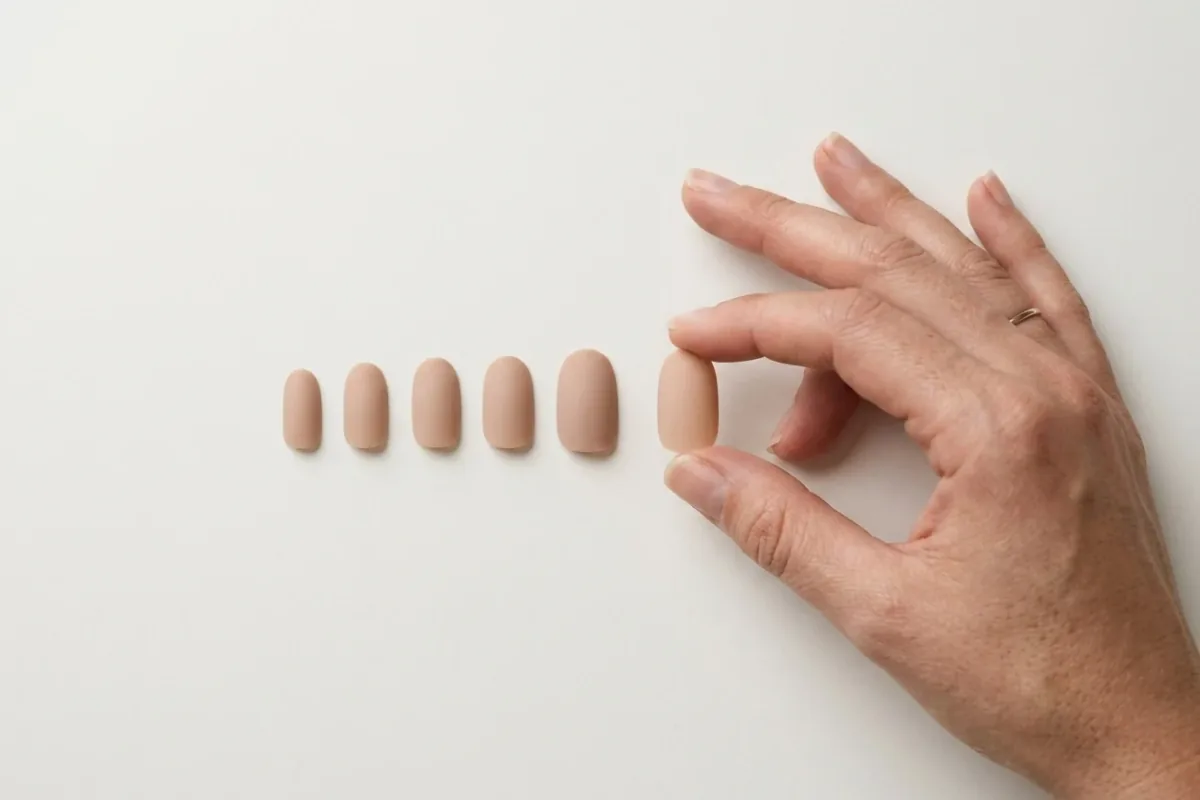
Sizing is the easiest thing to get wrong and the thing that matters most for wear time. A nail that is too narrow leaves a strip of natural nail on each side, and that strip is where water and knocks get in. One that is too wide presses into the skin and lifts at the corner within hours.
Measure the width of each nail at its widest point, straight across. A ruler works, a soft tape measure works better. Write the ten numbers down in millimetres, and measure both hands. Most people have a clear difference between left and right.
Then lay the set out and hold each size against the nail before any glue appears. The right size covers edge to edge without touching the skin at the sides. Caught between two sizes, take the larger one and file it down at the sides until it fits. A tip that is too narrow leaves the corners of the nail bare, and that is where water and soap get in.
Shape and length
Shape decides how long you can stand wearing the set. A short almond or a soft square survives keyboards, shopping bags and zips. Long coffin and stiletto look excellent for three days and are in the way for the rest of the week, at least in our experience. If a set has to last a full working week, go one length shorter than you planned.
The prep that actually decides wear time
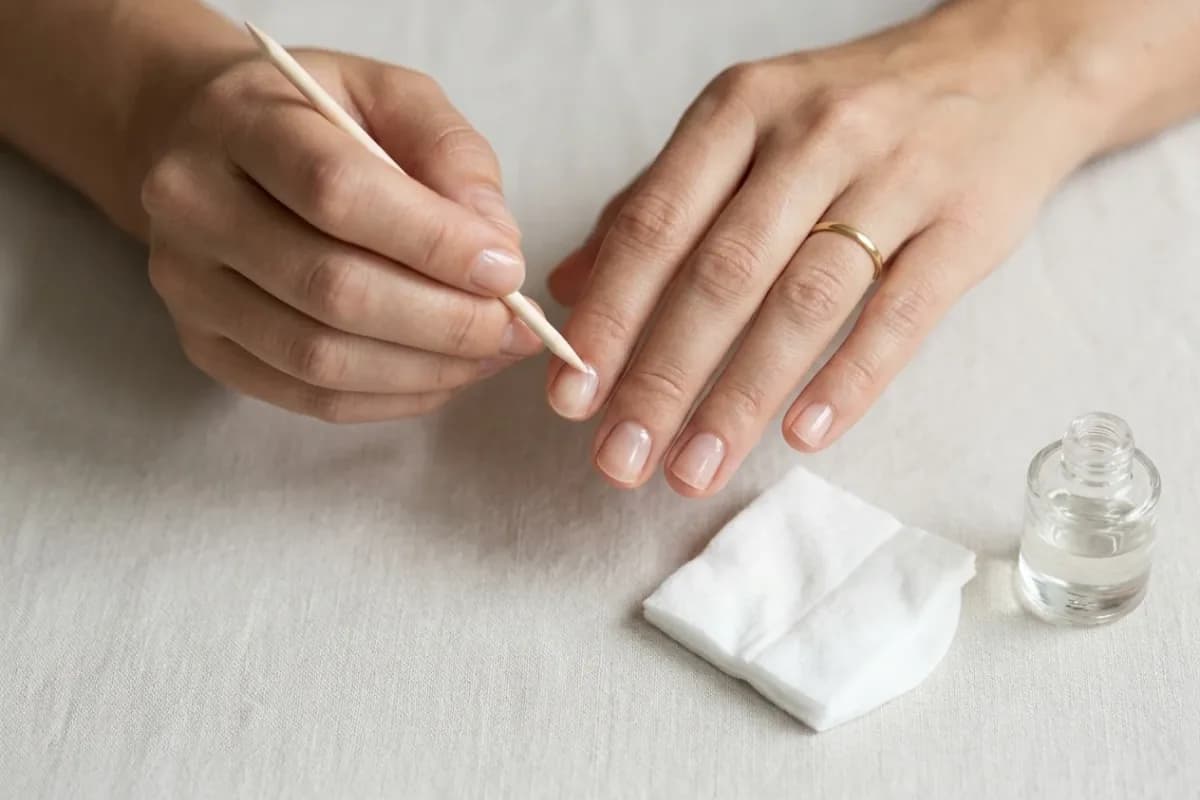
Almost every set that lifts early lifts because the nail was not clean and dry when the glue went on. Rarely because the glue was bad.
- Wash your hands with soap and dry them properly. No hand cream before you start.
- Push the cuticle back gently with a wooden stick. Push, never cut. The cuticle is a seal against bacteria and it needs to stay intact.
- Trim and file your natural nail short enough that the press-on lies flat against the plate the whole way.
- Wipe the plate with a little surgical spirit on a cotton pad and let it air dry completely. This removes oil and moisture, and it is the step people skip.
- Look at each nail. If one is sore or loose, skip that finger.
We never sand the surface of the natural nail to give glue something to grip. That is removing nail, and nail grows back over months, not days. A set that needs a sanded plate to stay on is failing for other reasons, and those reasons are further up this page.
Application step by step
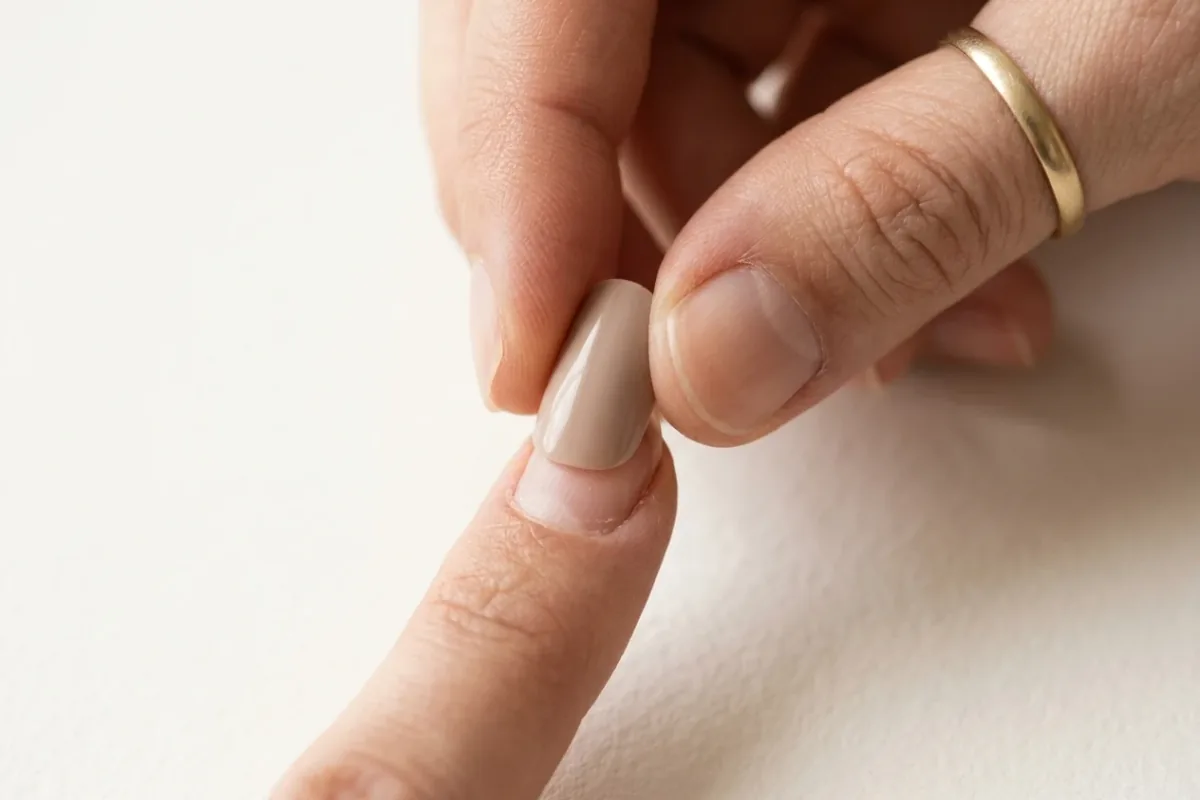
Set aside twenty minutes and do it somewhere your hands can be left alone afterwards. Glue does not cope well with being disturbed in the first few minutes.
Start at the little finger and work in towards the thumb, so finished nails are never in the way of the next one. Put a small drop of glue in the middle of the natural nail, not right up to the cuticle, and a thin line on the inside of the press-on. Angle it in towards the cuticle first, lower it towards the tip, and press for ten to fifteen seconds with even pressure.
If the glue spreads across the whole surface without squeezing out onto skin, you used the right amount. If it runs down the side, you used too much. That is the common mistake, and you wipe it away straight away with a dry cotton bud.
Adhesive tabs as an alternative
Adhesive tabs are double-sided pads you press into place with no drying time. Tabs hold for less time, often a day or two, but they are kind to the nail and the set comes off with almost no work. For a single evening we choose tabs. For a full week we choose glue.
Wait at least an hour before washing your hands, showering or cooking. It is dull advice, and it is also the difference between a set that lasts a week and a set that lifts tomorrow.
How long a set lasts, and what shortens it

Most sets we have worn last about a week. Some go two, some lose a nail on day three. It tracks what your hands are doing far more closely than what the set cost.
These shorten wear time the most:
- Hot water over time. Washing up without gloves, long baths, saunas.
- Hand sanitiser and cleaning products straight onto the edge.
- Using your nails as tools. Opening a drinks can is the classic.
- Moisture under the edge. Once water has found its way in, more follows.
- Cream or oil right before application, so the glue never got a proper hold.
A nail lifting at the corner can usually be saved. Wash and dry under the edge, add a small drop of glue, press down and hold for half a minute. If the same nail lifts a third time, the size is probably wrong, and taking it off beats gluing it again.
If the whole set starts lifting at once after a few days, take it off and start clean. Re-gluing corners on a set that is finished gives water and bacteria somewhere to live.
How to take a set off gently
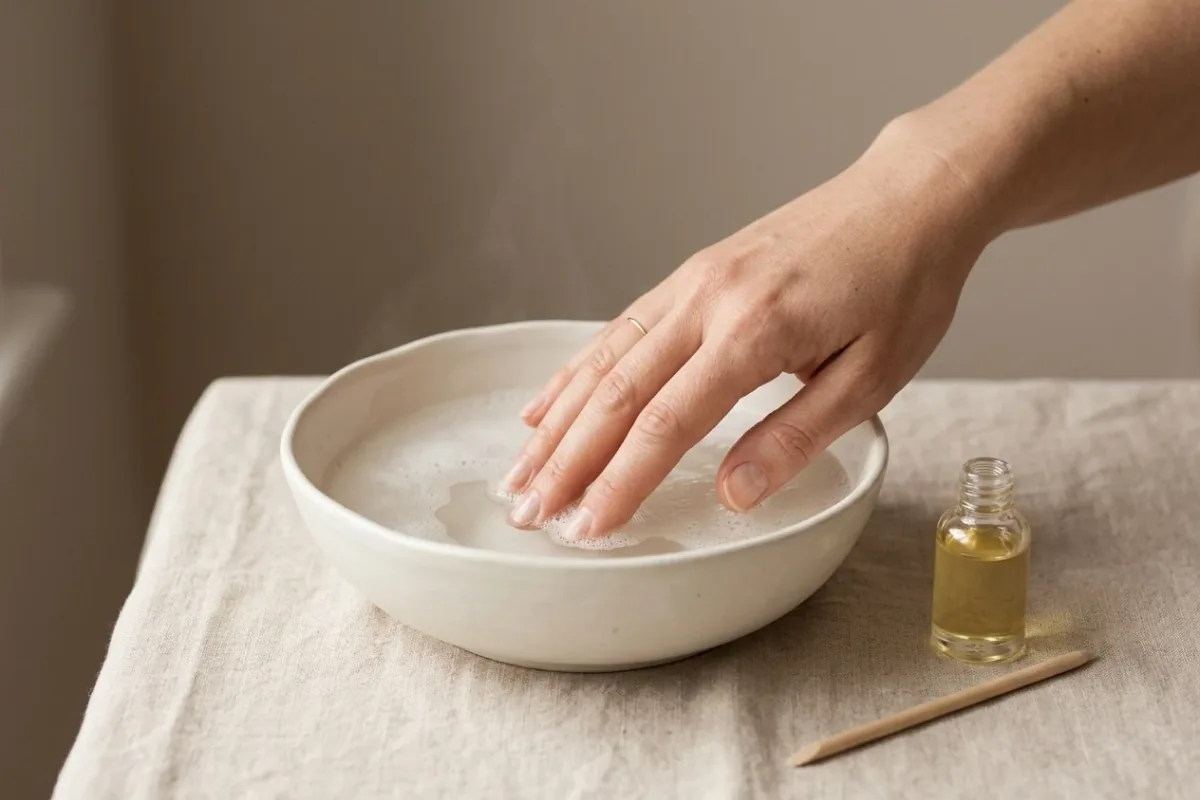
Removal is where nails actually get damaged, and it takes about fifteen minutes if you do it calmly.
Fill a bowl with comfortably warm water and a few drops of mild soap or shower gel. Put your hands fully under the water and leave them there for ten to fifteen minutes. The water works its way under the edge and softens the adhesive. That is the whole method. The rest is patience.
Then work a drop of cuticle oil around the edge of each nail while they are still warm and damp. The oil creeps into the gap the water opened. Rest a wooden stick lightly against the edge at the base and rock it gently from side to side. The word is rock, not lever. If the nail does not move, it is not ready, and the hand goes back in the water for another ten minutes. Soaking twice is completely normal.
If a nail has already lifted slightly at the base, you can slide dental floss into the gap and walk it forward. Only ever into a gap that is already there.
Do not use acetone. It pulls the oil and moisture straight out of the nail plate, which then stays white, rough and brittle for weeks, and you do not need it: warm soapy water and a little time release the glue perfectly well. You should also never pull, snap or file your way through a set, and metal tools do not belong under the nail edge.
Once the set is off, wash your hands, add cuticle oil and hand cream, and leave your nails bare for a few days if they feel tender.
Looking after the nail between sets
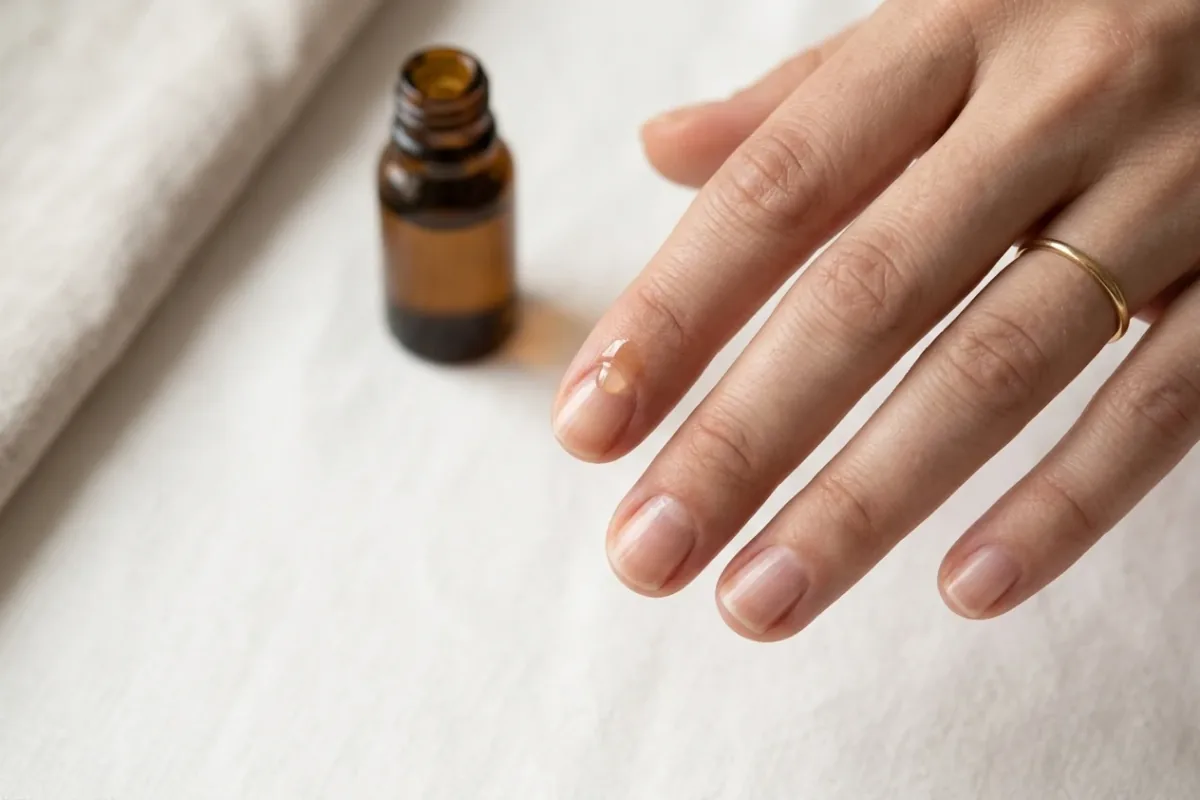
The nail under a set is usually in fine condition, but it is drier than normal right after removal. That is the water and the glue, not damage.
Cuticle oil is the one thing that makes a real difference, and it needs using more often than most people think. Once a day for a few days, worked around the cuticle and over the plate itself. Hand cream afterwards holds the moisture in.
We take a couple of days off between sets. Not because the nail needs to breathe, it gets everything it needs from the blood underneath, but because two days give you the chance to spot a problem before you glue over it. A white patch, a loose corner or something that hurts is only visible on a bare nail.
There is more on dry nails, cuticles and hands that survive winter in our nail tips.
How to reuse a set
A set usually survives three to five rounds if you take it off carefully and tidy it up afterwards.
Scrape the glue residue off the inside while it is still soft from the soak. A wooden stick is enough. Wash the nails in a little soapy water, dry them, and put them back in the tray in the right order so you do not have to measure again. If an edge has gone rough, smooth it with a buffing block. The buffing block goes on the press-on, never on your own nail.
Reuse is also why one more expensive set can end up cheaper than three cheap ones. Solid plastic survives being taken off and put back on. A thin set tends to crack on the first removal.
If we have not answered something here, the usual questions live under questions and answers, and new tests go up as we finish them on the blog.