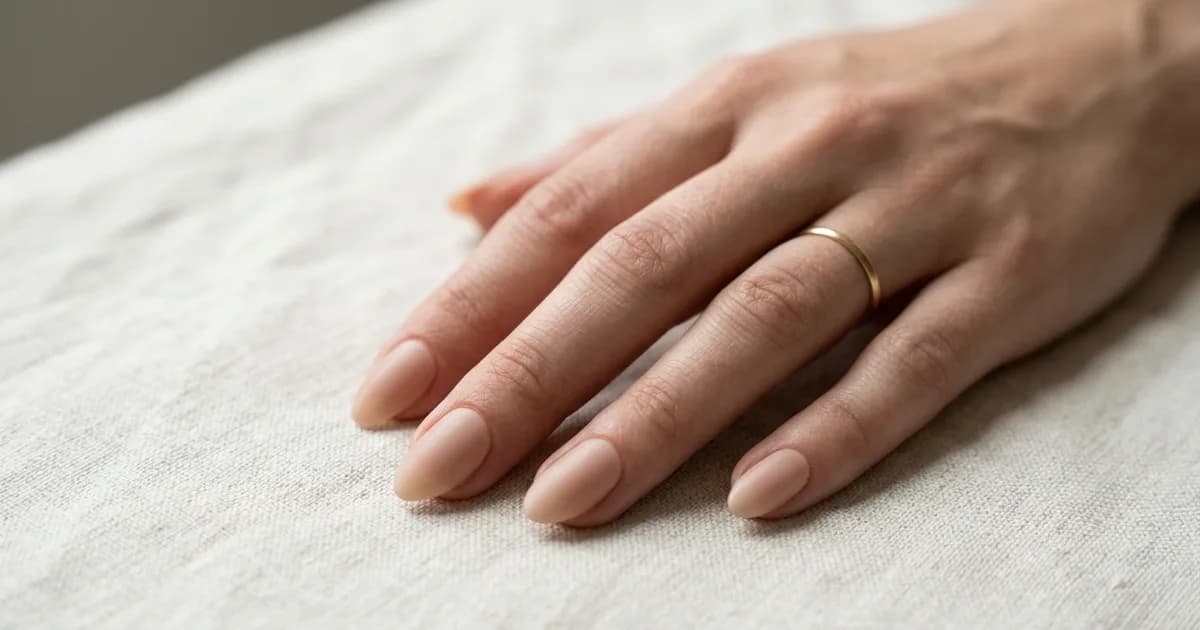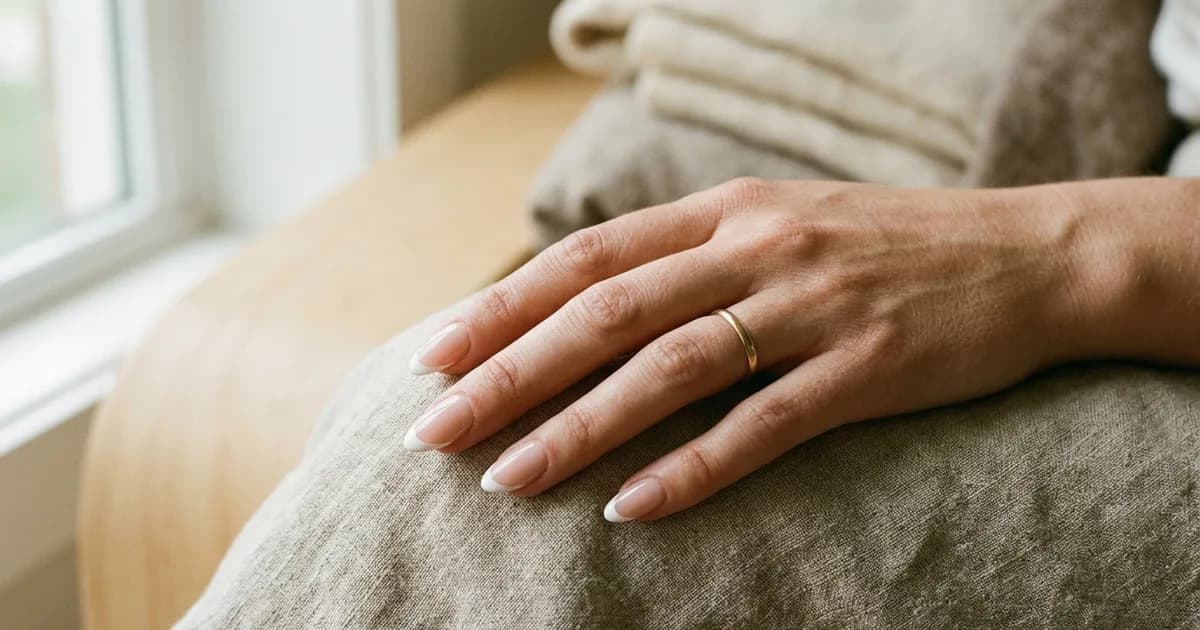
A french manicure in press-on nails gives you the white tip and the nude base ready-made, without painting a single stroke. You pick the size, press it on, and have a clean french in a couple of minutes instead of half an hour with a steady hand and a thin brush. The question everyone asks is whether it looks real, and the answer is yes, as long as the shape fits your nail and the white edge is thin enough.
I have worn a french press-on set through a week of dishes and typing, and what separates one that looks fake from one that does not is almost never the colour. It is the width of the white edge and how high it sits. Here is how to get it right, on both regular and very short nails, and how the nail underneath does once the set comes off.
French as a press-on, without painting the tip
A french press-on is a ready-made nail with a white tip and a nude or soft pink base that you glue straight onto your own nail. You skip the filing, you skip the curing lamp, and you skip the hardest part of all, which is painting an even white curve freehand.
Most of our sets are soft gel, so they flex a little with the nail instead of feeling like a hard shell on top of it. The white curve is moulded in from the start, and that is exactly what lets a french press-on look clean even if you have never held a nail brush. The look itself is not new. It turned up in the seventies as a neutral nail that went with everything, and it has stuck around because it still does.
If you want to know how a set behaves from the moment you glue it on to the moment it comes off, the whole picture is in our guide to press-on nails on the pillar page.
How a french manicure looks real
What decides whether a french looks real is neither the brand nor the price. It is three things: how thin the white edge is, how it curves, and whether the base sits close to your own skin tone.

A real nail tip is narrow. The white stripe on a natural nail is rarely more than a couple of millimetres, and it curves softly down towards the sides. When the white field on a set is wide and flat, it reads as fake from across the room. Choose a set with a thin, soft curve and you land much closer to something that looks like your own nail on a good day.
The base matters as much as the curve. A chalky pink-white base on a warm skin tone looks a bit mask-like, while a nude with a hint of what you already have in your skin melts into the finger. Much of the same thinking applies when you want a set to look like your own nails, just with a pale edge on top.
Then there is where the white part sits. The line should fall roughly where your own nail ends and the free edge begins. If it sits too far down towards the fingertip, the nail looks short and squeezed. That is why sizing matters more for a french than for a plain nude, where a millimetre either way barely shows.
French on short nails, and the micro french
French suits short nails better than most people think, but only if the white edge shrinks along with the nail. On a short nail the white should be thin enough to read as a hint, what is often called a micro french.

A wide white tip on a short nail does two things at once, and neither of them is flattering. It eats up the little nail you have, and it pulls the eye straight to how short the nail is. A thin line does the opposite. It gives a clean edge without taking up room.
If your nails are already very short, a short square or squoval shape with a micro french is what I would pick myself. It looks tidy in an instant and handles a normal day of typing and washing up. How you find the right size and a length that actually survives a weekday is something I have written about in a separate post on short sets. Most of it applies as much to a french as to a plain nail.
Shapes and colours that suit a french
A classic french sits nicely on almost any shape, but almond and short square are the two that look most natural. The almond gives a soft, feminine tip where the white curve follows the point neatly, and it suits most hands. Short square is the safest everyday shape, simply because it looks most like a well-kept natural nail.
The colour does not strictly have to be white at all. A french in a warm cream rather than a pure white is softer and more forgiving, and it looks less harsh in daylight. If you want a bit more going on, there is french with a silver shimmer or a frosted edge, and a black or dark french is a whole other mood that works well in the evening. If you are after colour with a capital C instead, we cover the darker tones that suit autumn elsewhere.
We run the xnails.no shop ourselves, so you know where the advice comes from. But the principle holds wherever you buy the set: a thin curve and a base close to your skin tone do more for the look than any other choice you make.
The nail underneath once the set is off
Then there is the nail underneath, as always. A french press-on wears the nail no more than any other set does, as long as you do not file the surface before you glue, and you do not pull the set off when you are tired of it.
The white tip actually makes one thing easier. Because the look is already pale and clean, it shows less when your own nail grows out over a few days. You get a thin stripe at the cuticle whatever the colour, but on a french it nearly disappears into the pale finish. That means the set looks tidy a few days longer than a dark colour would, and the nail underneath is glad of it.
When it is time to take the set off, do it with warm soapy water and a little patience, never by prying it loose while it is dry. The whole gentle method is in the guide on taking a set off without damaging the nail. Give the nail a couple of days with nothing on afterwards, and a little oil in the evening. It recovers just fine.
Questions about a french manicure in press-on nails
Does a french press-on look real?
Yes, when the white edge is thin and curves softly, and the base sits close to your own skin tone. It is the wide, flat white tip that gives a set away, not the fact that the nail is applied. Choose narrow and soft, and you get a long way.
How long does a french press-on last?
About the same as other sets, so five to ten days with glue and a little less with adhesive tabs. The upside is that grown-out nail shows less on a french than on a dark colour, so it tends to look tidy a couple of days longer than it strictly is.
Does french work on very short nails?
Yes, but pick a micro french with a thin white line. A wide tip makes a short nail look even shorter, while a narrow edge gives a clean look without eating up the length you have.
Can I reuse a french press-on?
Usually yes, if the nail came off whole and you get the glue residue off the back with a little oil. The white edge handles another round fine, as long as the nail itself has not cracked. Your nail matters more than saving a set either way.